



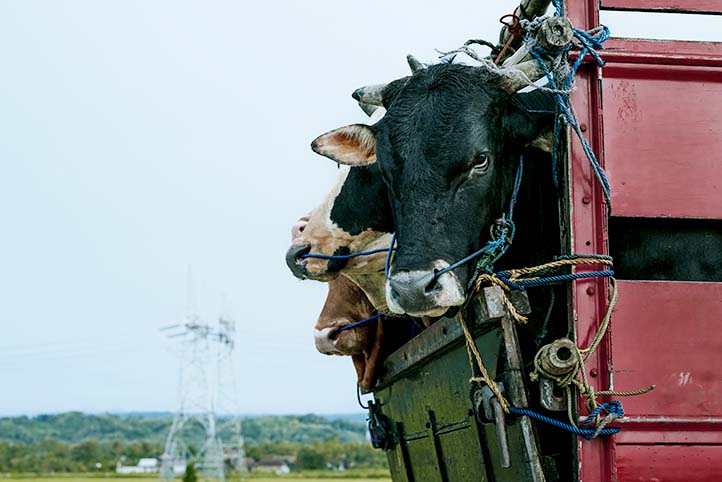
It seems obvious enough. If you’re concerned about cows, dairy’s the way to go. Nobody gets killed, right? The cows spend pleasant lives grazing in the fields, coming in for milking every now and then. Right? Contrast that with the horrors of the slaughterhouse.
Unfortunately, things aren’t so simple. The small family farms on which dairy cattle could roam between milkings are mostly gone now. Instead, most dairy cattle live out their lives in huge sheds where they’re treated more like machines than animals. Bred to produce unnatural amounts of milk (annual milk production per cow has more than doubled since the 1940s), dairy cows are plagued with calcium deficiencies and painful mastitis. Their natural lives would span some 25 years, but instead they are routinely sent to slaughter before their fifth birthday. They become hamburger and “processed” beef.
Like humans, cows have to give birth in order to produce milk. To keep production high, they are artificially inseminated once a year. Nine months later, a calf is born. 24 to 48 hours after that, the calf is taken away. Milk production must be maximized. Don’t wanna waste the stuff on a calf. If the calf is female, she usually gets to live and follows her mother’s path to the dairy. If the calf is unfortunate enough to be male, however, he is sent off to the veal farm instead. He might as well be sent to hell.
While his mother languishes, mourning the loss of her calf, he is chained by the neck inside a tiny crate, just two feet wide. He sees no daylight and eats no grass. Fed an antibiotic-rich, iron-deficient gruel so that his meat will be pale, the young calf has no room to walk or turn. He can’t even lie down comfortably. By the time he’s led to slaughter at just 16 weeks of age, chances are good that he will unable to walk at all. According to the Humane Society of the USA, this veal industry to which he will succumb is based entirely upon ‘surplus’ dairy calves.
Contrast his life to those of beef cattle. It’s not much, but at least many of them have access to range land for part of their lives…until they’re sent to fatten up at the feedlot.
Which brings us to some of the other costs of both beef and dairy. There are about 10 million cattle in Canada, 5 million of them adults. Something like 200,000 of these are dairy cows. All except the veal calves are fed grains and soy beans for a significant part of their lives. Dairy cattle eat it all their lives. It takes about 10 kg of grain to ‘grow’ 1 kg of beef and about 15 kg of grain to produce 30 liters of milk. By the time a dairy cow goes to slaughter, she’ll have consumed some 40 lbs of grain for every lb of hamburger that she becomes. This is very expensive business. Imagine how much less farm land we’d need to cultivate if we didn’t eat meat or dairy. Imagine how many more human mouths we could feed.
And cattle don’t just eat. They discharge manure and they belch methane. Pound for pound, their methane warms our planet more than CO2 does. Their manure contaminates our ground water. With the growth of factory farming, animals live in close quarters. Their manure is collected in large “holding ponds’ where it sometimes overflows or otherwise seeps into the ground. Dairy cattle contribute more to this problem because they usually live their entire lives under these close quarter conditions.
The fact that cows live in these close quarters has another consequence for us humans. Because they are packed so closely together, disease can spread quickly. To prevent this, farmers dose them up with antibiotics. Among other things, this has the effect of loading up their meat and milk with antibiotics, too. Pesticides and other chemicals from the grains they eat accumulate as well.
Not surprisingly, dairy cattle – who frequently suffer from mastitis, and eat more grain than their ‘beef-producing’ kin – have the highest levels of antibiotic and pesticides in their bodies. The US FDA has found that 60% of the hamburger with chemical residues over allowable limits comes from dairy cattle.
What can you do about it?
You might try to mitigate some of the damage by buying organic. At least the cows see pasture and you won’t be loading yourself up with unwanted chemicals. Remember, though, that even organic dairy calves become veal, and that an awful lot of grain goes into raising even organic cattle. The environmental costs of raising any food animal are high. If you really want to have an effect, cut back your consumption dramatically or, best of all, avoid meat and dairy altogether.
Which is worse? Dairy or beef? You be the judge.
Photo by Afif Kusuma on Unsplash