



If you grew up in Canada, you might remember an extremely catchy jingle for an “amusement park” in Niagara Falls, Ontario ending with “Everyone loves Marineland!”. While this earworm of a jingle may be familiar, you may not be familiar with the alarming animal cruelty taking place at Marineland.
In full transparency, I have been to Marineland as a child and regrettably, as a younger adult. I’m a theme park enthusiast, so prior to being vegan and without doing any research, I went for the roller coaster and left feeling extremely bad for the animals. Since going vegan, I have been trying to stay up-to-date and educated about Marineland and its practices. This blog will outline some recent developments that have brought Marineland’s harmful practices to light and how you can help.
What animals are at Marineland?
According to the Marineland website, the park continues to remain open even under adapted COVID-19 protocols. The Marineland park, which opened in 1961, has a mix of attractions, ranging from family thrill rides and more intense roller coasters, to the more problematic animal “attractions”. According to the Marineland website, the following animals can be viewed at the park:
- white whales (for viewing, touching and feeding);
- beluga whales (for viewing, feeding and touching);
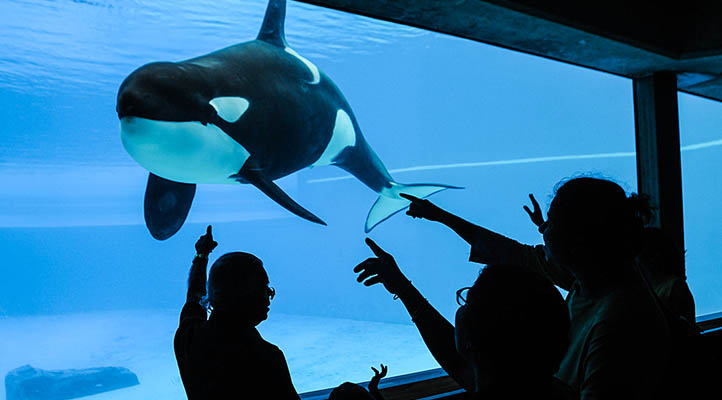
- a single killer whale named Kiska;
- walruses including Smooshi, the subject of a recent documentary;
- penguins at a new penguin exhibit; and
- land animals including North American Black Bears, Bison, Elk, Red Deer, and Fallow Deer.
Alarming Practices and Resulting Protests
Marineland has long held a reputation for cruelty to its animals. As far back as the 1980s, people began protesting the theme park. The CBC has profiled Frank, an animal lover, who, as a former teenage employee of Marineland saw first hand how the animals were treated. Frank’s early protests inspired many others that followed. Now, each year on Labour Day weekend, crowds of protesters gather outside Marineland, anywhere from dozens in the past, up to more than a thousand.

Back in 2012, a Toronto Star investigation revealed some of the suffering experienced by animals at Marineland, after interviewing several former employees. The former employees spoke of “what the public doesn’t see” regarding the deterioration of marine mammals that become sick, suffer fur loss, skin damage and even blindness as a result of recurring water problems. They also shared that staffing shortages also resulted in the animals not receiving a minimum standard of care.
According to a PETA petition, dozens of dolphins and whales have died at Marineland, including a walrus named Apollo who suffered a heart attack. The petition also notes an orca is currently confined in isolation, after being abducted from her family in the wild as a baby 40 years ago. Keep reading for an update on Kiska, this poor orca.
Just recently, a months-long inspection of Marineland by Ontario’s animal welfare watchdog revealed that marine mammals at Marineland were in distress due to the poor water quality. On May 10, the inspectors issued two orders to Marineland to repair the water system in the pools housing beluga whales, dolphins, walruses, sea lions and Kiska.
Despite all of these claims from former employees and investigations, the owners of Marineland have always denied any harm being done to the animals.
Recent Updates- #FreeKiska
The problems at Marineland don’t stop there. In July, former Marineland employee and whistleblower Phil Demers, tweeted a distressing video showing an orca moving slowly and listlessly at the surface of the water. This orca is named Kiska, and she is the last surviving orca at Marineland.
You may recall that in 2019, the Ending the Captivity of Whales and Dolphins Act was passed, making it illegal to keep any whales in captivity in Canada. However, the whales already in captivity, like Kiska, were grandfathered in and permitted to stay where they are.

After Demers’ tweeted this video, Animal Justice filed a formal animal cruelty complaint with provincial authorities, requesting an investigation into the apparent suffering of Kiska. (In case you’re not aware, Animal Justice is Canada’s only national animal law advocacy organization. Its executive director, Camille Labchuk, was recently the featured speaker of Earthsave’s speaker series).
According to the Animal Justice blog post about their recent action, Kiska was tragically stolen from her family in the ocean near Iceland in 1979 when she was a calf, and sold to the aquarium industry. She has been held captive in a tank at Marineland all by herself since 2011, and has outlived all five of her babies, who died at early ages.
Animal Justice also notes that according to Dr. Naomi A. Rose, one of the world’s leading experts on orcas and other marine mammals, Kiska is believed to be the only orca in the entire world who lives completely alone.
Camille Labchuk was interviewed by the CTV regarding Kiska’s situation. According to Labchuk, moving Kiska is “unfortunately unlikely.” Labchuk explained that orcas from captivity don’t have any survival skills or any social networks that would enable them to be released back into the wild. Animal Justice is “hopeful” that Kiska may one day be moved to a whale sanctuary, like the one being built in Nova Scotia. In the meantime, however, there are things Marineland could do to improve Kiska’s conditions, including providing her with more sensory stimulation and cognitive enrichment, or placing her with other marine animals for social stimulation like the belugas or dolphins.
How can you help?
Sign a Petition: The recent media coverage about Kiska has revitalized a two-year-old petition about Kiska’s situation, which can be found here. Another petition can be found here.
Demonstrate: Join one of the many Marineland protests in the Niagara Falls region. You can also spread the word on social media, using the hashtag #FreeKiska.
Be intentional about what attractions you support or don’t support: Please don’t make my mistake! I’ve learned now to always do my research, and only support attractions that don’t involve animals at all or are designed to exclusively support animals (i.e. animal sanctuaries).
Donate: The Boycott Marineland group is raising money for the Whale Sanctuary Project in Nova Scotia. Donate to Animal Justice to support their important legal work. If you are interested in promoting veganism more generally, don’t forget that Earthsave Canada is always grateful to receive donations that support our public advocacy.
Photo: We Animals Media, Kiska being pointed at by visitors to Marineland